
Duck and Cover
And Other Advice for Politicians and Those Near Them

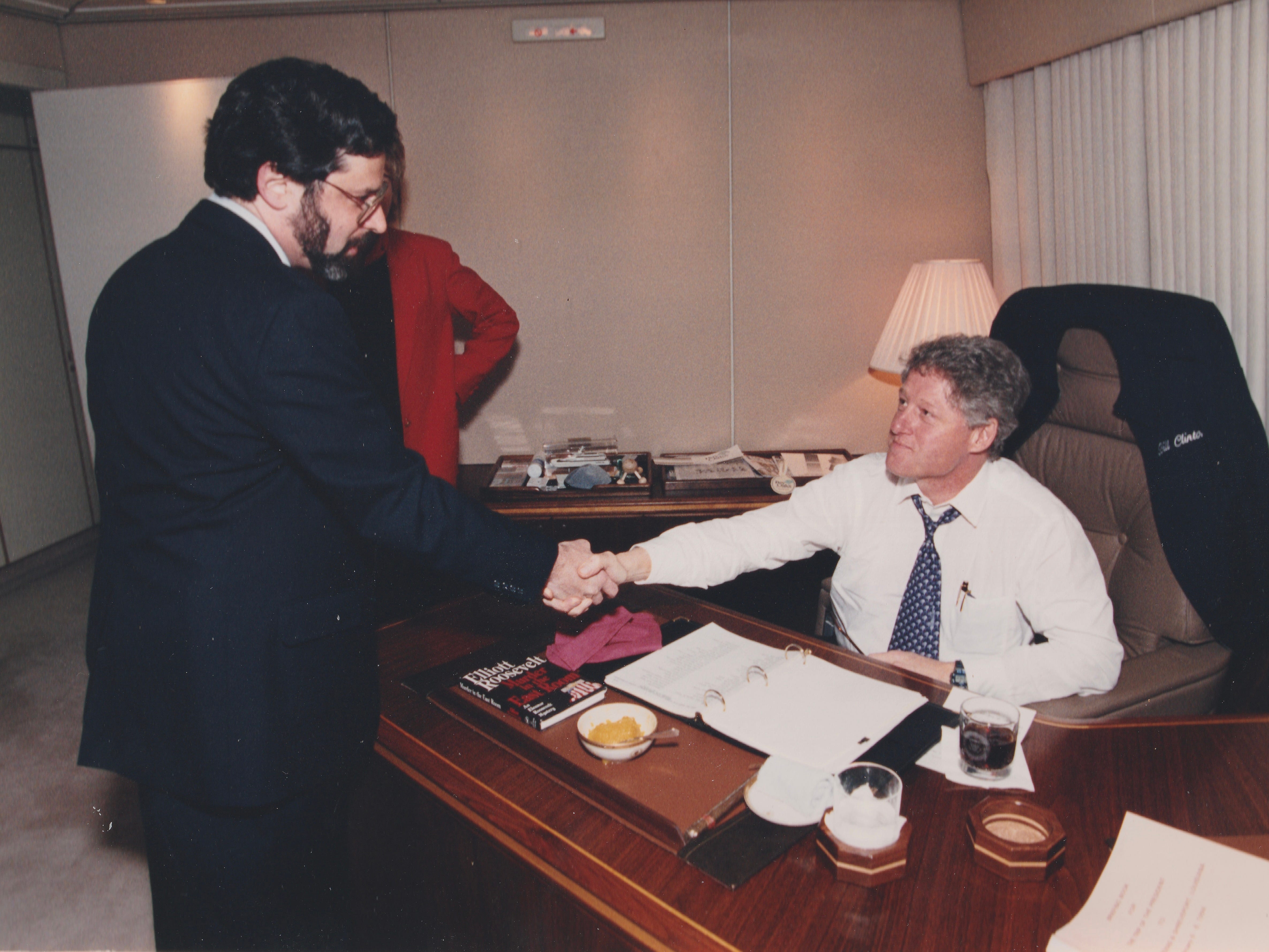
I covered the White House early in the Clinton Administration.
Whenever you’re close to the president two things are true—you are at risk and you are inside the safest possible security perimeter.
Both those facts were in evidence Saturday night when an armed man ran toward the ballroom where President Trump was attending the White House Correspondents’ Association Dinner. I attended one of those dinners in that same room in the 1990s.
When sharp sounds penetrated the air and security officers shouted, “Shots fired! Get down!” photos show some guests in tuxedoes and ballgowns taking cover under tables, while others stay in their chairs or even stand up to see what’s going on. One man famously continues eating.
I suspect it’s the reporters with war zone experience who are under the tables. That’s one thing you learn in Hazardous Environments Training and covering conflict zones, as I did in Iraq and Afghanistan as a Pentagon correspondent in the late 2000s, in Manila during the Philippine revolution, and in Gaza, the West Bank and elsewhere. Much as you might want to see what’s going on, you’re smarter to take cover at least until you get an idea what the danger is and where it’s coming from.
As for the president’s location being the safest possible place to be, that’s a relative statement. You’re certainly safer in your home or office, or pretty much anywhere the average person goes. But if you’re going to put yourself in a potential danger zone, the area around a Secret Service protectee, especially the president, is the place to be. Most of the candidates in this year’s elections will not have such protection.
One reporter at a briefing Saturday night referred to the incident as a security “failure.” I can see where he’s coming from, and certainly no one wants an attacker to be even as close as this one was. But as far as we know, he breached only the ballroom’s outer-most security perimeter, which was in the process of being taken down because no one else was to be allowed in. He was stopped at the next level by closed doors and a phalanx of armed security officers.
Saturday night’s attack will no doubt be the focus of a significant review of presidential security, as is every such incident. But this is not a repetition of what happened in Butler, PA, when a man got to a location he shouldn’t have been allowed to reach and managed to fire several rounds, wounding the president. It’s more like the Palm Beach incident, when security officers noticed and stopped a potential attacker before he tried to breach their perimeter. Those two outdoor venues are much harder to secure than a hotel ballroom with limited entry and exit points.
This event does, however, raise the question of what might have happened if the man had not been acting alone—if several people with more sophisticated weapons had run down that hallway, and maybe several accomplices had attacked another entry point at the same time. In today’s America, it’s not hard to imagine a scenario in which an organized group does a better job of planning than this attacker did. Such a group could well get closer to accomplishing its mission or, perish the thought, even succeed.
Indeed, that is the premise of my new novel Body Man, based largely on my White House experience and set squarely in today’s divided America.
But does this argue, as President Trump did Saturday night, for building a secure facility like his White House ballroom? From a narrow security perspective, maybe. But we don’t want the President of the United States sheltered in that sort of steel-reinforced, bulletproof bubble. In our democracy, the president needs to be out among the people to the greatest extent possible, as has always been the case, and as Trump acknowledged Saturday night.
Rather than a hardened bunker, we need two things: the security review, which we will no doubt get, and a serious effort by American leaders of all stripes to lower the temperature of our political discourse, preach for civil debate and ostracize those who espouse or even suggest violence.
That we probably won’t get, except maybe for a few days, especially with politicians fighting hard for every seat the mid-term election campaign already in progress.
It is not President Trump’s responsibility alone, and he’s not famous for taking the high road, but he could do a lot to get a longer-term temperature-lowering started. Saturday night he praised the “unity” in the room during those tense moments. If he can sustain that approach, it could be a first step toward making it safe, indeed necessary, for other Republican leaders to do the same, and encourage all Democrats to follow suit.
-0-
Smart analysis by an accomplished journalist, war correspondent and author. Right on the money Al. Thanks for sharing.